- Family owned since 2011
Vinyl Siding vs. Fiber Cement in Franklin, TN: The 2026 Material Selection Guide for Williamson County Homes
2,000+
Five-Star Reviews
5,000+
Projects Completed
15 Years
In Business
24/7
Emergency Response

Franklin's 2026 Siding Showdown: What Actually Survives Our Climate?
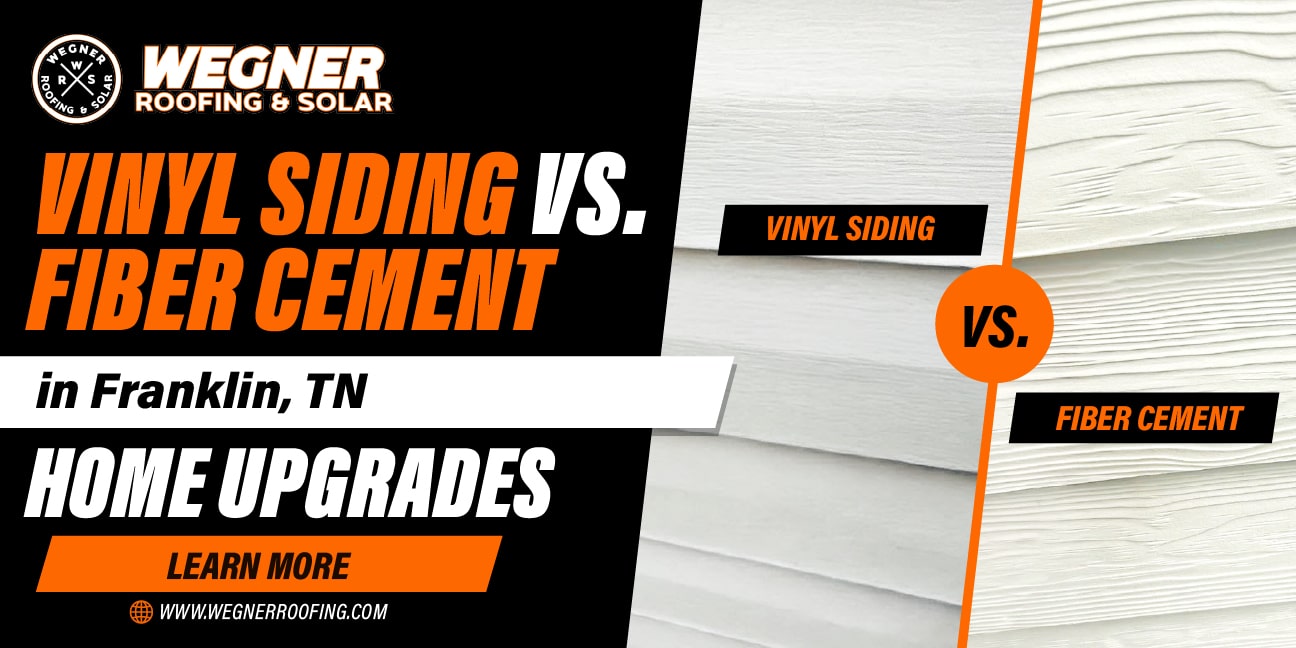
Deciding between vinyl siding vs fiber cement for your Franklin home? The immediate answer is straightforward. Fiber cement resists Middle Tennessee’s intense hail and outlasts vinyl by roughly thirty years. However, vinyl requires a significantly lower initial investment and never needs repainting. Your final choice depends heavily on your HOA rules and sun exposure.
Williamson County brings extreme humidity and severe storm seasons that destroy the wrong exterior materials. To protect your investment for decades, we must look at how each option handles our specific weather. We have analyzed local storm data and installation patterns across Brentwood and Spring Hill to help you make an informed decision. Picking the wrong material means facing expensive repairs in just a few years.
Not sure which material fits your home? Schedule an on-site siding evaluation with our Franklin, TN team, we’ll walk your property, check your sun exposure and HOA guidelines, and give you a straight answer before you spend a dollar on materials.
Franklin's Climate Verdict: Why Material Choice Beats Price Here
Williamson County sits in a humid subtropical zone (Köppen Cfa), and that classification matters more to your siding decision than most homeowners realize. Franklin’s relative humidity averages 85 percent in January mornings and stays above 68 percent even in the driest months of August and September. That’s a year-round moisture load, not a seasonal one.
Middle Tennessee Humidity and Moisture Cycling
Vinyl siding doesn’t absorb moisture, which sounds like an advantage until you consider what happens behind it. Standard vinyl panels are installed with a 1/4-inch expansion gap and rely on a separate weather-resistant barrier to manage the moisture that gets behind the panel through seams and cut edges. In a climate where the dew point swings dramatically between a 47°F January morning and a 91°F July afternoon, that gap becomes an entry point for condensation if the house wrap underneath is compromised. When diagnosing ventilation, exterior insulation, and roofing Franklin TN homes require an airtight transition where soffits meet siding to prevent trapped attic moisture from rotting wall studs.
Fiber cement, by contrast, is a cementitious composite of Portland cement, sand, and cellulose fibers. It doesn’t warp, but it is porous at a microscopic level, which is precisely why manufacturers like James Hardie factory-seal all six sides of every plank before it leaves the plant. An unsealed cut edge on a fiber cement board left exposed through a wet Franklin autumn will wick moisture and can eventually delaminate. This is a detailed problem, not a materials problem, and it’s the single most common installation error we correct on second-opinion inspections in Cool Springs and Berry Farms.
The May 2025 Hail Event: What Baseball-Sized Stones Near Franklin Revealed
On May 8 and again on May 20, 2025, severe thunderstorms dropped hail ranging from 1.75 inches to confirmed baseball-sized stones (roughly 2.75 inches) across Williamson County, with damage reported directly in Franklin, Thompson’s Station, Spring Hill, and Brentwood. Insurance adjusters and local contractors documented cracked vinyl panels, punctured soffits, and dented gutters throughout the impact zone. In instances where stone impacts penetrated asphalt shingles alongside exterior cladding, pairing wall restoration with a complete roof replacement allowed homeowners to consolidate their insurance claims into a single deductible.
Vinyl siding rated for standard impact resistance (most builder-grade panels installed in Franklin subdivisions between 2005 and 2015) will crack or shatter under hail larger than about 1 inch in diameter, especially in cooler temperatures when the polymer becomes more brittle. Fiber cement, being roughly 5/16-inch thick and cement-based, absorbed those same May 2025 impacts with surface chipping in isolated cases but far fewer full-panel failures. If your neighborhood was in the orange zone on the May 8th hail map (1.75-inch stones or larger), that’s a direct, local data point in favor of fiber cement’s impact rating, not a generic claim.
UV Exposure and Color Retention Through a Franklin Summer
Franklin logs about 44 days a year above 90°F, concentrated in June through August. Standard vinyl siding is colored all the way through the extrusion, but darker colors (navy, charcoal, forest green) absorb enough heat under direct Tennessee sun to warp or “oil canning” over 8 to 12 years, particularly on south and west-facing walls. Fiber cement products like James Hardie’s ColorPlus finish use a baked-on, factory-applied coating with a 15-year fade warranty, which holds true color on the sun-exposed sides of two-story homes common in Westhaven and Fieldstone Farms far longer than vinyl’s cap-stock color.
Vinyl Siding in Franklin: Composition, Lifespan, and Fit
Vinyl siding is an extruded PVC (polyvinyl chloride) panel, typically 0.040 to 0.046 inches thick for standard grades and up to 0.052 inches for premium grades. In Franklin’s climate, a properly installed standard-grade vinyl panel lasts 20 to 25 years before UV brittleness and seam separation become a replacement issue. Insulated vinyl, which bonds a rigid foam backer to the panel, pushes that lifespan closer to 30 years and adds an R-value of roughly 2 to 5, depending on foam thickness.
Standard vs. Insulated Vinyl: What's Actually Different
Standard vinyl is hollow behind the panel, which means it flexes with temperature swings and can telegraph wall imperfections underneath. Insulated vinyl fills that cavity with expanded polystyrene, which stiffens the panel, reduces the “oil canning” ripple effect on hot days, and improves the R-value of the wall assembly.
The tradeoff is cost: insulated vinyl runs 20 to 35 percent higher than standard panels, and it cannot be reused if a panel needs replacement. When calculating the cost of siding replacement in Franklin, TN, consider whether the added insulation could save enough energy to justify the higher material cost for your home.
Where Vinyl Fails First on Williamson County Homes
The most common vinyl failure point we see on Franklin service calls isn’t the field of the wall, it’s the trim. J-channels and corner posts around windows and doors take the brunt of thermal expansion and contraction, and in homes built before 2010, we regularly find gaps that have let moisture behind the panel for years without visible exterior signs. The second most common failure is impact damage from lawn equipment or hail on ground-floor walls facing the street, which is a cosmetic issue on newer homes but can expose the house wrap on older installations.
Best-Fit Neighborhoods for Vinyl
Vinyl remains a smart, budget-conscious choice for the builder-grade housing stock common in parts of Spring Hill and Nolensville, where homes were constructed with vinyl as the primary exterior material and matching replacement panels are still readily available from the same manufacturers. If your subdivision doesn’t have an architectural review board restricting exterior materials, vinyl gives you the fastest, lowest-cost path to a finished exterior.
Fiber Cement Siding in Franklin: Composition, Lifespan, and Fit
Fiber cement siding, when properly installed and maintained, lasts 30 to 50 years in Franklin’s climate, roughly double the lifespan of standard vinyl. It’s heavier (roughly 3 to 4 pounds per square foot versus vinyl’s 0.5 to 1 pound), which means it requires proper wall-stud spacing and doesn’t flex the way vinyl does under wind load, an advantage during Middle Tennessee’s spring severe weather season.
James Hardie ColorPlus and the Westhaven/Cool Springs ARB Factor
Many of Franklin’s newer planned communities, including sections of Westhaven and Cool Springs, operate under architectural review boards (ARBs) that specify or strongly prefer fiber cement or comparable non-vinyl materials to maintain a consistent aesthetic standard across the neighborhood. If you live in one of these communities, checking your ARB guidelines and the latest City of Franklin residential building permit requirements before selecting a material isn’t optional; it can determine whether your project gets approved at all. James Hardie’s ColorPlus technology applies the finish in a controlled factory environment rather than on-site, which produces a more even, durable coat than field-painted siding and is a detail ARB committees frequently reference when approving material submissions.
Real-World Maintenance Cadence
Primed fiber cement (unfinished, painted on-site) needs repainting roughly every 10 to 15 years depending on sun exposure. Factory-finished ColorPlus panels typically don’t need repainting for 15 to 25 years, though caulking at seams and trim joints should be inspected annually, especially after a wet Tennessee spring. Because fiber cement doesn’t expand and contract as dramatically as vinyl, that caulking holds up longer, but it isn’t maintenance-free.
Best-Fit Neighborhoods for Fiber Cement
Fiber cement is the stronger fit for historic Downtown Franklin homes near Main Street and the Franklin Theatre, where architectural character and resale value both benefit from a premium material, and for newer construction in Berry Farms and Westhaven, where ARB guidelines and buyer expectations lean toward the material’s durability and finish quality.
Vinyl vs. Fiber Cement: Head-to-Head Comparison
Attribute | Vinyl Siding | Fiber Cement Siding |
Material composition | Extruded PVC, 0.040 to 0.052 in. thick | Portland cement, sand, cellulose fiber, 5/16 in. thick |
Lifespan in Franklin, TN climate | 20 to 25 years (standard), up to 30 years (insulated) | 30 to 50 years |
Impact resistance (hail) | Cracks at impacts above ~1 in. diameter | Withstands most impacts up to 1.75 to 2 in.; surface chipping possible above that |
Moisture handling | Does not absorb water; relies on house wrap and gaps for drainage | Factory-sealed edges resist moisture; field-cut edges must be sealed on-site |
Color retention (UV) | Cap-stock color; dark colors may warp in 8 to 12 years under direct sun | ColorPlus factory finish rated for 15 years fade resistance |
Maintenance cycle | Occasional washing; no repainting | Repaint every 10 to 15 yrs (primed) or 15 to 25 yrs (ColorPlus); annual caulk check |
Installed cost (relative) | Baseline (lowest) | 40 to 60% higher than vinyl |
HOA/ARB approval in Franklin communities | Often restricted in newer planned communities (Westhaven, parts of Cool Springs) | Generally preferred or required in ARB-governed neighborhoods |
Weight per sq. ft. | 0.5 to 1 lb | 3 to 4 lbs |

Case Study: A Westhaven Homeowner's Material Decision
Consider a home in Franklin’s Sullivan Farms facing west with intense afternoon sun. The original builder-grade vinyl siding showed visible warping on the west elevation by year nine. During the May 2025 hail event, twelve brittle panels shattered, prompting an insurance claim.
The homeowner could replace the damaged vinyl at a lower cost or upgrade to fiber cement. Because storm restoration frequently reveals hidden perimeter damage, consulting our Franklin TN homeowners guide to roofing helped coordinate new flashing alongside the siding remodel.
They ultimately chose fiber cement. A west-facing wall enduring Franklin’s 44 annual days above 90°F is highly vulnerable to vinyl warping. Additionally, impact-resistant fiber cement significantly boosts resale value in Williamson County. This proves that material selection relies entirely on specific wall exposure, climate data, and long-term homeowner goals rather than abstract preferences.
A Simple Decision Framework for Your Williamson County Home
Work through these four questions in order. Each one either eliminates an option or confirms it.
1. Does your HOA or ARB restrict exterior materials? (Timeline: check your covenant documents or call your HOA management company; takes about a day.) If fiber cement or a non-vinyl material is required, this decision is already made for you.
2. Which walls get direct afternoon sun (south or west-facing)? (Timeline: a five-minute walk around the property.) If you’re choosing vinyl for a south or west wall, budget for a lighter color to reduce warping risk, or price out fiber cement for that elevation specifically.
3. How long do you plan to own this home? (Timeline: your own decision, no research needed.) Under 7 years, vinyl’s lower upfront cost usually wins on ROI. Beyond 10 years, fiber cement’s longer lifespan and stronger resale positioning in Franklin’s competitive housing market typically offsets the higher install cost.
4. What’s your risk tolerance for the next hail season? (Timeline: review your insurance deductible and past claims history.) If you’ve filed a storm damage claim in the last three years, or your neighborhood was in a documented 2025 hail zone, fiber cement’s impact resistance reduces the odds of repeating that claim cycle.
Once you’ve worked through these four questions, you’ll know which material fits your specific house, not just which one is generally recommended. When you begin to compare siding installation quotes Franklin TN contractors submit, check that each bid accounts for site-specific details like flashing tape, factory-finished cut sealing, and waste factors rather than generic flat rates.
Frequently Asked Questions
Is fiber cement worth the extra cost over vinyl in Tennessee?
Yes, if you’re staying in the home more than 10 years or live in a hail-prone area. Fiber cement’s 30-to-50-year lifespan and stronger impact resistance typically justify its 40-to-60-percent higher upfront cost over that time horizon.
Which siding handles Middle Tennessee humidity best?
Fiber cement handles Franklin’s 68-to-85-percent relative humidity slightly better long-term, since factory-sealed edges resist moisture wicking. Vinyl performs fine too, but only when the house wrap and cut-edge sealing behind it are installed correctly.
How long does vinyl siding last in Tennessee?
Standard vinyl siding lasts 20 to 25 years in Franklin’s climate before UV brittleness and seam issues typically require replacement. Insulated vinyl panels extend that lifespan to roughly 30 years under normal conditions.
Does fiber cement siding need painting?
Primed fiber cement needs repainting every 10 to 15 years depending on sun exposure. Factory-finished products like James Hardie ColorPlus typically go 15 to 25 years before repainting is needed.
What siding is best for storm-prone areas?
Fiber cement withstands hail up to roughly 1.75 to 2 inches in diameter far better than standard vinyl, which cracks at impacts above about 1 inch. Williamson County’s May 2025 hail events, which included baseball-sized stones, demonstrated this gap directly.
Weathering the Storm: Confident Siding Choices for Franklin
The choice between vinyl siding vs fiber cement ultimately comes down to balancing your immediate budget with your long-term plans. While vinyl offers an affordable, low-maintenance solution for shorter stays, fiber cement provides unmatched durability against Franklin’s severe weather and high humidity.
Upgrading your exterior can feel overwhelming, but you do not have to navigate this significant investment alone. At Wegner Roofing & Solar, we understand how much your home means to your family’s daily comfort and long-term security.
Reach out to our local team today to discuss your specific property and neighborhood requirements, and let us help you build a beautiful, resilient exterior that you can trust for decades to come. See why your neighbors trust us by checking out the latest reviews on our Wegner Roofing & Solar Google Business Profile.
Get Your Free Estimate